


At Alif Semiconductor, we like to tell the story of how our Ensemble and Balletto family microcontrollers came to have their unique advantages – off-the-scale low-power operation, scalability and true code portability, heavyweight security built-in, and the hardware features needed to run real audio and video AI locally at the edge or endpoint.
Our origin story says that these unique advantages come from our decision as a start-up in 2019 to build a new MCU architecture from scratch. We had the luxury of creating the ideal MCU, because unlike other MCU manufacturers, we were not burdened with a legacy of existing products that could only be incrementally upgraded.
Of course, a story is just a story. So it is nice when the story is validated by real-world experience. And this is what has happened with the launch of the AE3 camera system from the OpenMV project. When Alif’s Henrik Flodell sat down recently with Kwabena Agyeman, president and co-founder of OpenMV, Kwabena explained how the development of the AE3 had taken advantage of important features of the Ensemble E3 MCU: he highlighted in particular the huge provision for working memory – 13.5MB of SRAM connected to a wide 64-bit AXI bus operating at 400MHz. As Kwabena says, ‘that gives you the equivalent of DDR4 speeds’.
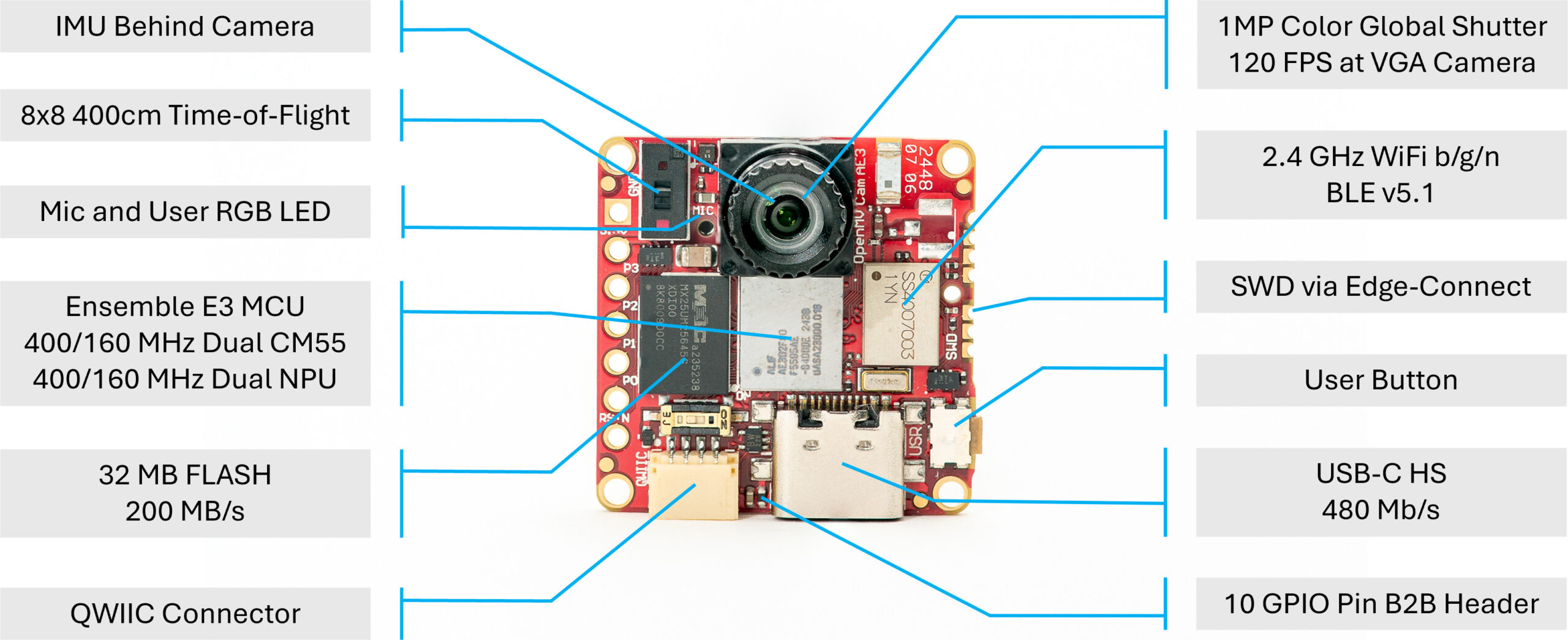
This reflects a core philosophy of Alif which underlies its development of the Ensemble and Balletto products: that an MCU’s performance is not determined by the headline CPU clock speed – the whole data processing system, including memory and the data pipeline, affects real-world data throughput. And this is why the Ensemble E3 chosen by OpenMV has so much fast memory on-chip.
In fact, OpenMV has used the E3 to achieve remarkable AI performance: for instance, running a YOLO Nano algorithm at 25 frames/s, the entire AE3 product (including the E3 MCU) draws just 60mA of operating current. OpenMV also takes advantage of the Ensemble architecture’s provision of discrete 400MHz High Performance and 160MHz High Efficiency compute blocks. The YOLO object detection application runs on the High Performance block, but the AE3 can also run in background video monitoring mode using the High Efficiency block. In this always-on monitoring mode, the camera draws less than 5mA, and less than 50µA in sleep mode.
As Kwabena says, ‘When we ran the numbers on power consumption, we couldn’t believe it ourselves at first.’ OpenMV’s AE3 has achieved around a 400-500x improvement in the power: performance ratio compared to the earlier H7 product, and in a camera with a new, more compact form factor – the entire system’s footprint is just 1” x 1”.
The combination of exceptional image processing and AI performance and ultra-low power consumption makes the AE3 camera ideal for a new set of battery-powered applications in which, as Kwabena says, the battery can in many cases practically run for ever.
You can learn much more about the possibilities for video AI at the edge by watching Henrik’s and Kwabena’s conversation in full. And the AE3 camera is available to buy now directly from OpenMV.