

Dual-Core Gen AI Microcontroller
The Ensemble E4 series of Gen AI enabled microcontrollers are designed for applications demanding a combination of maximum power efficiency, high compute performance, hardware accelerated image processing and integrated security. Its innovative multicore design provides a dedicated system for power efficient operations, while the second core is ready to deliver high-performance processing when needed. In addition to the real-time cores, the E4 contains 3 NPUs that can operate independently, to fully enable advanced Edge AI/ML use-cases.
Key Benefits of E4:
-
High-Performance RTOS control and AI/ML (Artificial Intelligence/Machine Learning), including Transformer Networks and Gen AI
-
Over 15 MB of on-die memory for more performance, security, and lower power
-
Single chip imaging pipeline with up to 2 MIPI-CSI camera interfaces + Hardware ISP & image compression capabilities
-
Low-power MCU/NPU wakes system
-
User interface and networking
E4 Specifications
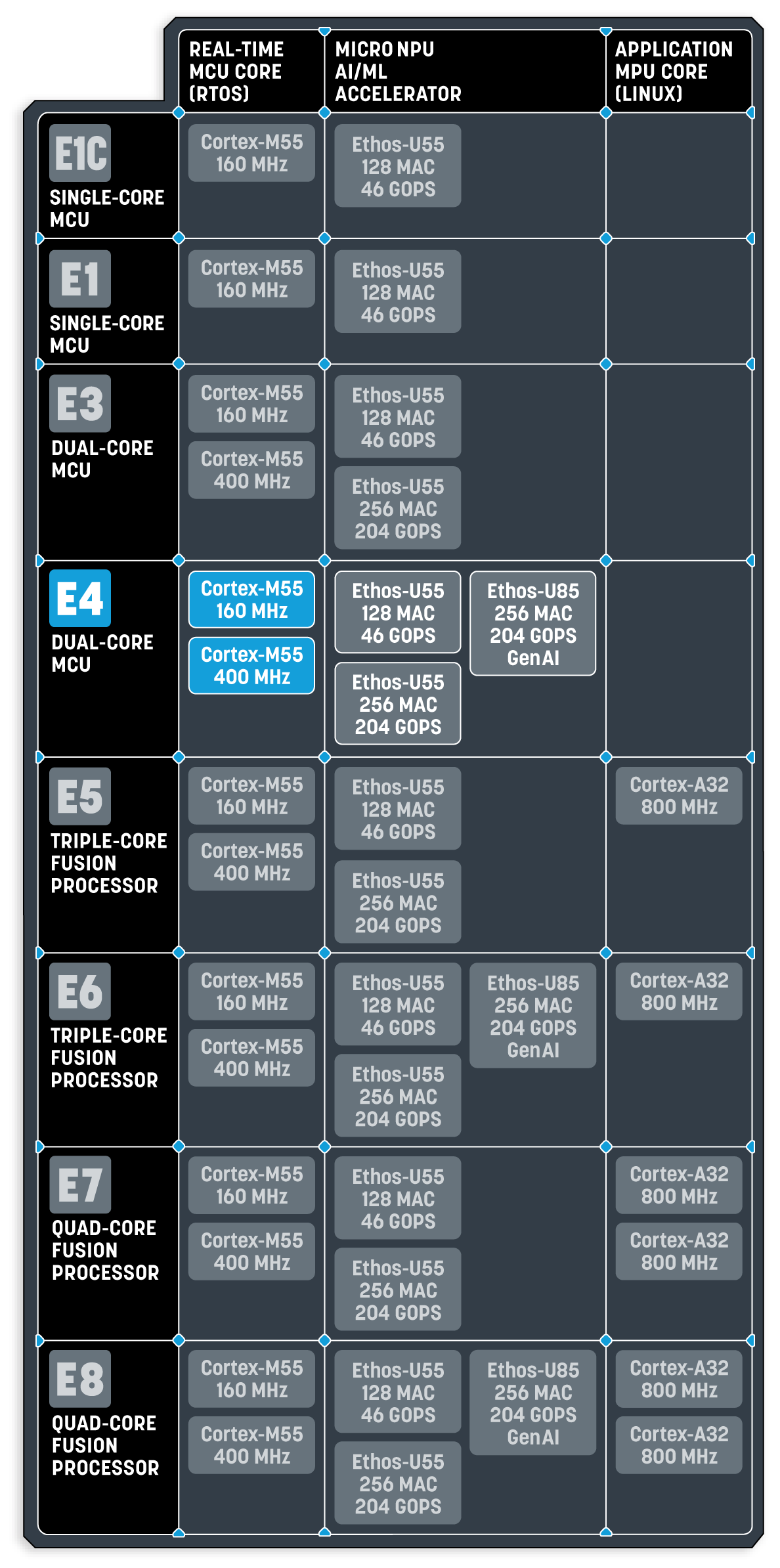
- High-Performance Arm® Cortex®-M55 Core, up to 400 MHz, with Helium™ Vector Processing Extension, Double-Precision FPU, 1.25MB SRAM 0-wait State Tightly- Coupled Memory, 32KB Instruction and Data Caches, Armv8.1-M ISA with Arm TrustZone®, and 4.37 CoreMark®/MHz Performance Benchmark
- High-Efficiency Arm® Cortex®-M55 Core, up to 160 MHz, with Helium™ Vector Processing Extension, DoublePrecision FPU, 512KB of SRAM 0-wait State Tightly Coupled Memory, 32KB Instruction and Data Caches, Armv8.1-M ISA with Arm TrustZone®, and 4.37 CoreMark®/MHz Performance Benchmark
- High-Performance 400-MHz 64-bit AXI Bus Fabric Common Across All CPUs
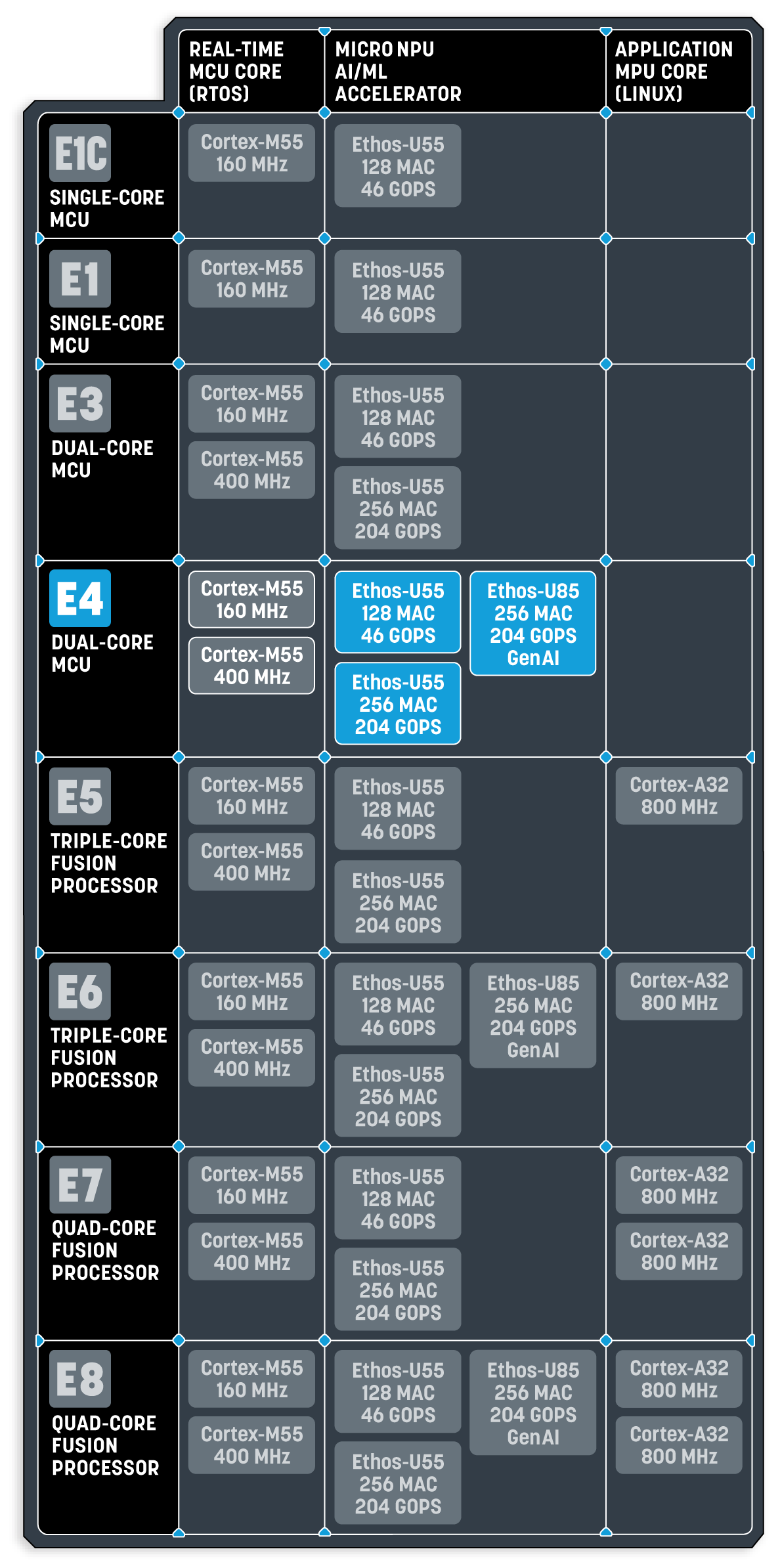
- 1× Arm Ethos™-U85 Neural Processing Unit (NPU) for Generative AI (NPU-HG), 256 MAC/cycle up to 400 MHz and 204 GOPS, Supporting Recurrent Neural Networks (RNN), Convolutional Neural Networks (CNN), and Transformer Networks, Fed by 128-bit wide High-Bandwidth Local Memory at over 12 GB/s
- 2× Arm Ethos™-U55 Neural Processing Units— 1× 256 MAC/cycle up to 204 GOPS, 1× 128 MAC/cycle up to 46 GOPS
- On-the-Fly Weight Decompression with Dedicated DMA Controller
- More than 800× Performance Uplift from Cortex-M4 for Inference Time
- Over 76× Less Energy Consumed when Using Ethos-U85 together with Cortex-M55
- Autonomous Intelligent Power Management (aiPM™)
- FD-SOI Low Leakage Process
- 1.3 µA Consumed in STOP Mode with LPRTC, LPTIMER, LPCMP, BOR, 4KB Utility SRAM, Wake Pins
- As Low as 27 µA/MHz Dynamic Consumption for High-Efficiency Cortex-M55
- Multiple Power Domains, Dynamic Power, Gating, Voltage and Clock Scaling, DC-DC Converter
- High Endurance MRAM Non-Volatile Memory
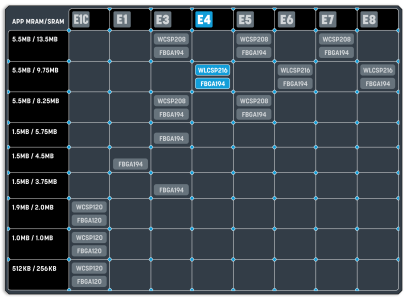
- Up to 5.5MB
- SRAM
- 9.75MB total SRAM: 8MB Bulk + 1.25MB M55-HP TCM + 0.5MB M55-HE TCM
- Optional Data Retention of Bulk SRAM and M55-HE TCM SRAM Contents
- 4KB Always-On Utility SRAM
- 2× 16-bit Hex SPI, each up to 400 MB/s SDR, 800 MB/s DDR, with Inline AES Decryption and Support for XIP and HyperBus
- 1× SD® v4.2, eMMC™ v5.1 Channel with DMA
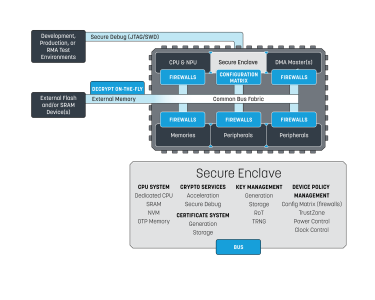
- Hardware-based Root-of-Trust (RoT) with Unique Device ID
- Secure Key Generation and Storage, Secure Certificate Storage
- Factory-provisioned Private Keys
- Crypto Accelerators—AES (up to AES-256), ECC (up to 384 bits), SHA (up to SHA-256), RSA (up to RSA-3072), and NIST compliant TRNG
- Secure Debugging with Certificate Authentication
- 12× Universal High-Resolution 32-bit Timers
- Capable of Motor and LED Lighting Control
- 3× Low-Power Universal High-Resolution 32-bit Timers
- 4× Watchdog Timers
- 4× Low-Power 32-bit Timers
- 1× Real-Time Counter
- 4× Quadrature Encoder Counters
- Works in Tandem with ISP to Store Compressed
- Images and Motion JPEG (MJPEG) Video Clips
- Maximum Performance: 2MP at 200 FPS
- Input Formats: YUV400, YUV420, YUV422, RGB
- Supports JPEG ISO/IEC 10918-1, ITU-T T.81
- Supports MJPEG T.81 Format
- Encoding Color Space: YUV 4:0:0, 4:2:0, 4:2:2
- Cropping, Rotation, Padding
- 1× 10/100 Ethernet with DMA
- 1× USB 2.0 HS/FS Host/Device with DMA
- 1× SDIO v4.1 Channel with DMA
- 1× CAN FD Channel up to 10 Mbps
- 1× MIPI® I3C® Channel
- 4× I2C Channels up to 3.4 Mbps Throughput
- 2× Low-Power I2C Channel
- 8× UART Channels up to 2.5 Mbps (4× with RS485 Driver Control)
- 1× Low-Power UART Channel
- 4× SPI Channels up to 50 Mbps Throughput
- 1× Low-Power SPI Channel
- 3× 12-bit ADC (18 Single-Ended Inputs)
- 1× 24-bit ADC (4 Differential Inputs)
- Programmable Gain Instrumentation Amplifier (1× to 128×)
- 2× 12-bit DACs (2 channels)
- 4× High-Speed Analog Comparators with 2.5-ns Response (16 Inputs)
- 1× Low-Power Analog Comparator (4 Inputs)
- Internal Temperature Sensor
- Internal Precision Reference Voltage
- 1× 2-Lane MIPI D-PHY CSI-2®, 2.5 Gbps each lane
- Option for 2× MIPI D-PHY CSI-2 Interface by using the MIPI D-PHY DSI in Slave Mode. Allows Interleaving Two Image Streams from Two Separate Image Sensors
- 1× Camera Parallel Interface (CPI), up to 16 bits
- 1× Low-Power CPI, up to 8 bits
- Clocked up to 400 MHz, 64-bit Bus Connection
- Maximum Input/Output Resolution: 2MP (1920 × 1080)
- Configurable Frame Rate Control: 1 to 60 FPS Input Monochrome Formats: 8-bit, 10-bit
- Conversions: Demosaic Bayer to RGB, YUV422 to YUV444 to RGB
- Output Formats: 8-bit Monochrome, RAW 8/10/12-bit with Raster Scanning, RGB888 Planar, YUV, Y-only
- Auto White Balance and Auto Exposure
- Gamma Correction
- Crop, Scale, Binning, Black Level, Gain
- Graphics LCD Controller
- 1× Display Parallel Interface (DPI), up to 24-bit RGB
- 1× 2-Lane MIPI D-PHY DSI®, 2.5 Gbps each lane
- D/AVE 2D Graphics Processing Unit
- 4× I2S Synchronous Stereo Audio Interfaces
- 1× Low-Power I2S Stereo Audio Interface
- 4× 2-channel Pulse Density Modulation (PDM) Microphone Inputs (8 Mono Microphones)
- 4× 2-channel Low-Power Pulse Density Modulation (LPPDM) Microphone Inputs (8 Mono Microphones)
- Up to 136× 1.8-V GPIOs (Shared with Peripherals)
- Up to 8× Selectable 1.8-V to 3.3-V GPIOs (Shared with Peripherals)
- LFRC – Internal Low-Frequency RC Oscillator (32.7 kHz, ±4%)
- HFRC – Internal High-Frequency RC Oscillator (Up to 76.8 MHz, ±2%)
- LFXO – External Low-Power Crystal Oscillator or Quartz Crystal (32.768 kHz)
- HFXO – External High-Frequency Crystal Oscillator or Quartz Crystal (24 MHz to 38.4 MHz)
- One Fractional-N PLL to Generate System Clock, Additional Fractional-N PLL to Generate Audio Clock
- Global Event Mapping to Configurable Triggers
- 3× 32-Channel General DMA Controllers
- CRC Calculation Accelerator with Programmable Polynomials
- Programmable Low Supply Voltage Detect Warning (Brown-Out Detect)
- Power-On Reset and Brown Out Reset
- Real-Time Clock
- JTAG/SWD Debug Interface
- 1.75 V to 4.8 V Primary Supply Range
- 1.08 V to 1.98 V I/O Supply Range (1.8 V I/O)
- 3.0 V to 4.0 V I/O Supply Range (3.3 V Flex I/O)
- -40 °C to 85 °C Extended Ambient Temperature Range
- -40 °C to 125 °C Extended Junction Temperature Range
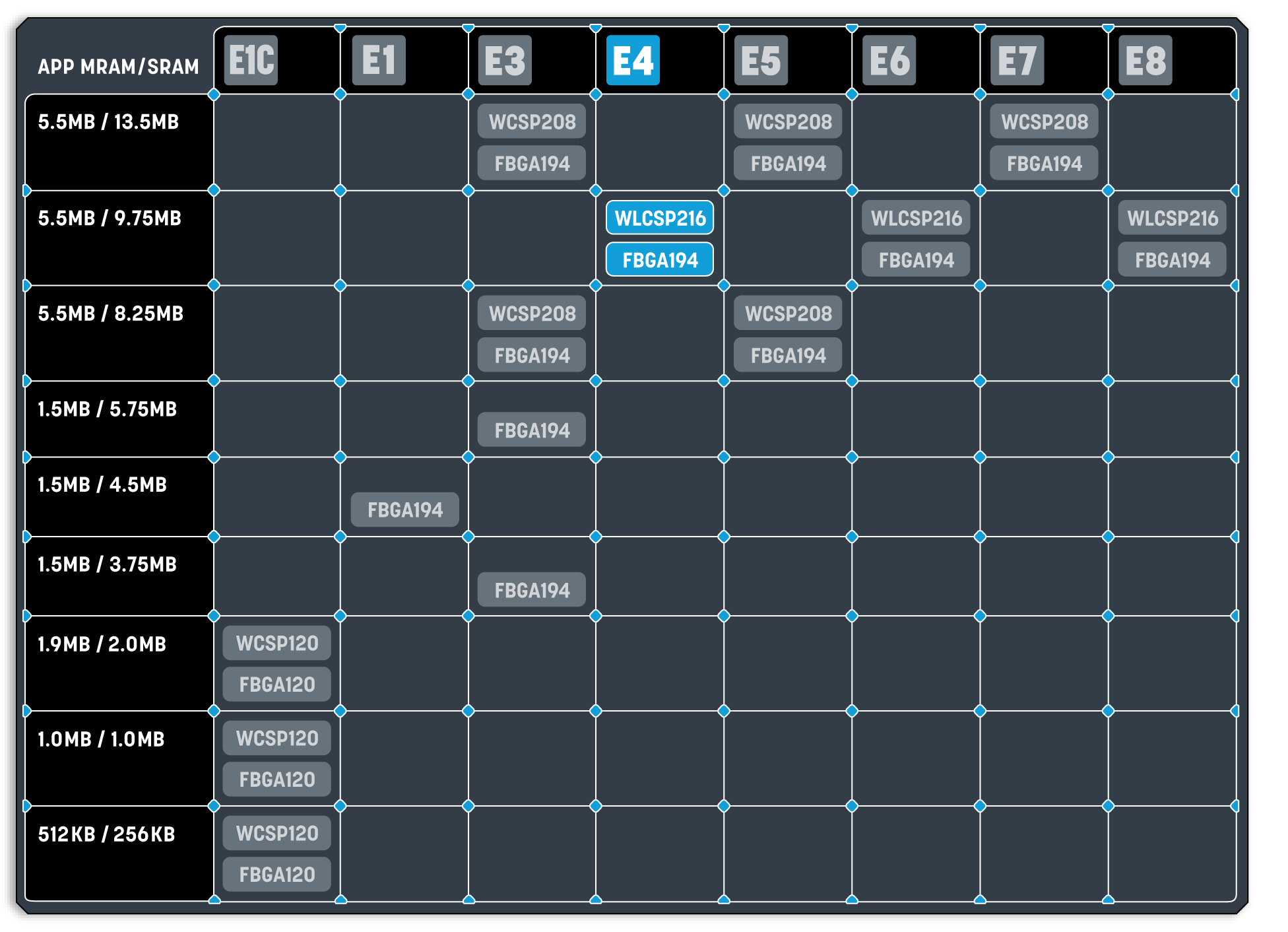
- WLCSP216, 0.4 mm Pitch
- FBGA194, 0.5 mm Pitch
High-Performance Dual-Core Microcontroller
- High-Performance Arm® Cortex®-M55 Core, up to 400 MHz, with Helium™ Vector Processing Extension, Double-Precision FPU, 1.25MB SRAM 0-wait State Tightly- Coupled Memory, 32KB Instruction and Data Caches, Armv8.1-M ISA with Arm TrustZone®, and 4.37 CoreMark®/MHz Performance Benchmark
- High-Efficiency Arm® Cortex®-M55 Core, up to 160 MHz, with Helium™ Vector Processing Extension, DoublePrecision FPU, 512KB of SRAM 0-wait State Tightly Coupled Memory, 32KB Instruction and Data Caches, Armv8.1-M ISA with Arm TrustZone®, and 4.37 CoreMark®/MHz Performance Benchmark
- High-Performance 400-MHz 64-bit AXI Bus Fabric Common Across All CPUs
Efficient Micro NPUs for AI/ML Acceleration
- 1× Arm Ethos™-U85 Neural Processing Unit (NPU) for Generative AI (NPU-HG), 256 MAC/cycle up to 400 MHz and 204 GOPS, Supporting Recurrent Neural Networks (RNN), Convolutional Neural Networks (CNN), and Transformer Networks, Fed by 128-bit wide High-Bandwidth Local Memory at over 12 GB/s
- 2× Arm Ethos™-U55 Neural Processing Units— 1× 256 MAC/cycle up to 204 GOPS, 1× 128 MAC/cycle up to 46 GOPS
- On-the-Fly Weight Decompression with Dedicated DMA Controller
- More than 800× Performance Uplift from Cortex-M4 for Inference Time
- Over 76× Less Energy Consumed when Using Ethos-U85 together with Cortex-M55
Extreme-Low Power Technology
- Autonomous Intelligent Power Management (aiPM™)
- FD-SOI Low Leakage Process
- 1.3 µA Consumed in STOP Mode with LPRTC, LPTIMER, LPCMP, BOR, 4KB Utility SRAM, Wake Pins
- As Low as 27 µA/MHz Dynamic Consumption for High-Efficiency Cortex-M55
- Multiple Power Domains, Dynamic Power, Gating, Voltage and Clock Scaling, DC-DC Converter
On-Chip Application Memory
- High Endurance MRAM Non-Volatile Memory
- Up to 5.5MB
- SRAM
- 9.75MB total SRAM: 8MB Bulk + 1.25MB M55-HP TCM + 0.5MB M55-HE TCM
- Optional Data Retention of Bulk SRAM and M55-HE TCM SRAM Contents
- 4KB Always-On Utility SRAM
External Memory Interfaces
- 2× 16-bit Hex SPI, each up to 400 MB/s SDR, 800 MB/s DDR, with Inline AES Decryption and Support for XIP and HyperBus
- 1× SD® v4.2, eMMC™ v5.1 Channel with DMA
Secure Enclave
- Hardware-based Root-of-Trust (RoT) with Unique Device ID
- Secure Key Generation and Storage, Secure Certificate Storage
- Factory-provisioned Private Keys
- Crypto Accelerators—AES (up to AES-256), ECC (up to 384 bits), SHA (up to SHA-256), RSA (up to RSA-3072), and NIST compliant TRNG
- Secure Debugging with Certificate Authentication
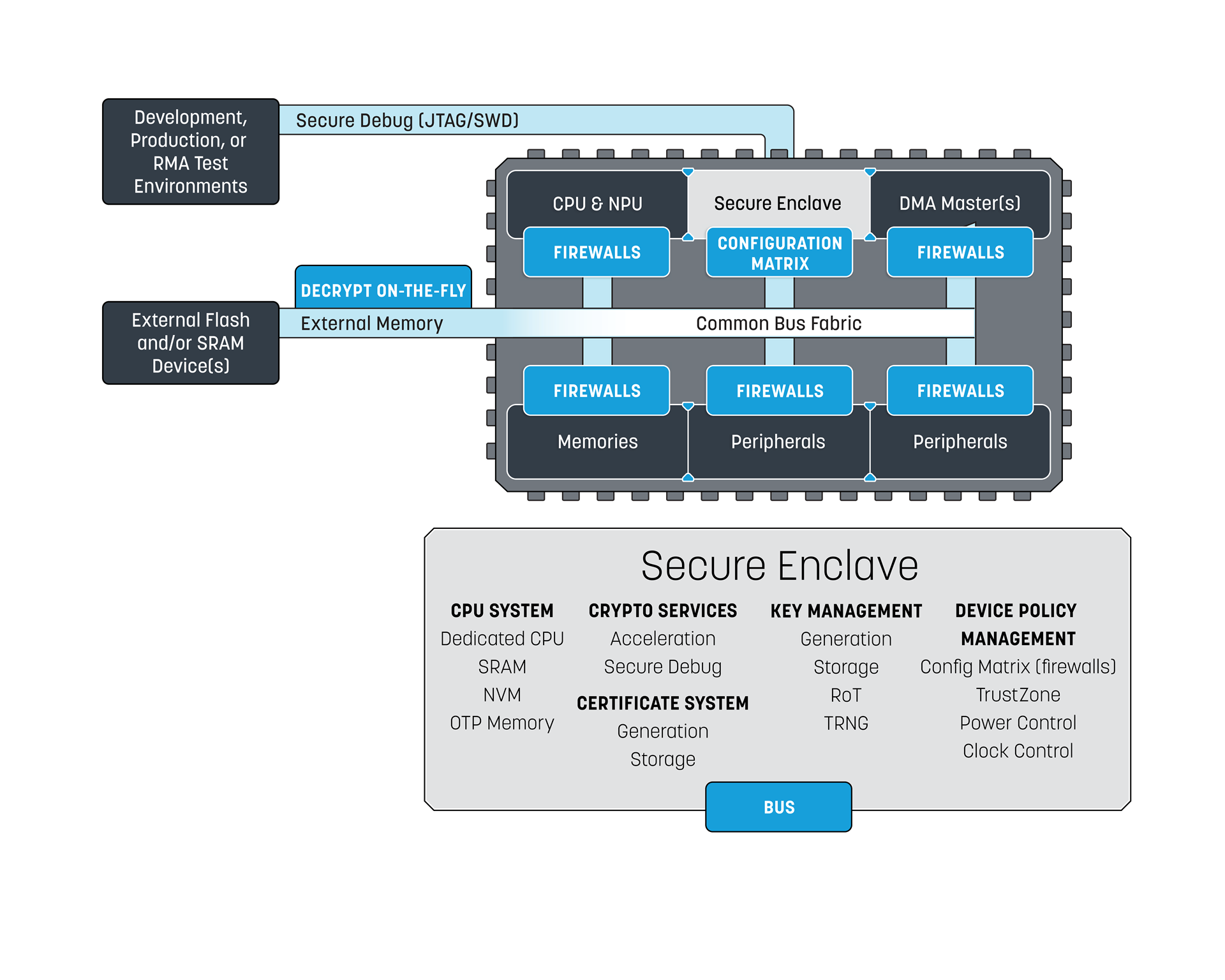
Timing Control and Measurement
- 12× Universal High-Resolution 32-bit Timers
- Capable of Motor and LED Lighting Control
- 3× Low-Power Universal High-Resolution 32-bit Timers
- 4× Watchdog Timers
- 4× Low-Power 32-bit Timers
- 1× Real-Time Counter
- 4× Quadrature Encoder Counters
JPEG Encoder
- Works in Tandem with ISP to Store Compressed
- Images and Motion JPEG (MJPEG) Video Clips
- Maximum Performance: 2MP at 200 FPS
- Input Formats: YUV400, YUV420, YUV422, RGB
- Supports JPEG ISO/IEC 10918-1, ITU-T T.81
- Supports MJPEG T.81 Format
- Encoding Color Space: YUV 4:0:0, 4:2:0, 4:2:2
- Cropping, Rotation, Padding
Serial Communication Interfaces
- 1× 10/100 Ethernet with DMA
- 1× USB 2.0 HS/FS Host/Device with DMA
- 1× SDIO v4.1 Channel with DMA
- 1× CAN FD Channel up to 10 Mbps
- 1× MIPI® I3C® Channel
- 4× I2C Channels up to 3.4 Mbps Throughput
- 2× Low-Power I2C Channel
- 8× UART Channels up to 2.5 Mbps (4× with RS485 Driver Control)
- 1× Low-Power UART Channel
- 4× SPI Channels up to 50 Mbps Throughput
- 1× Low-Power SPI Channel
Analog Interface Capabilities
- 3× 12-bit ADC (18 Single-Ended Inputs)
- 1× 24-bit ADC (4 Differential Inputs)
- Programmable Gain Instrumentation Amplifier (1× to 128×)
- 2× 12-bit DACs (2 channels)
- 4× High-Speed Analog Comparators with 2.5-ns Response (16 Inputs)
- 1× Low-Power Analog Comparator (4 Inputs)
- Internal Temperature Sensor
- Internal Precision Reference Voltage
Camera Interfaces
- 1× 2-Lane MIPI D-PHY CSI-2®, 2.5 Gbps each lane
- Option for 2× MIPI D-PHY CSI-2 Interface by using the MIPI D-PHY DSI in Slave Mode. Allows Interleaving Two Image Streams from Two Separate Image Sensors
- 1× Camera Parallel Interface (CPI), up to 16 bits
- 1× Low-Power CPI, up to 8 bits
ISP Acceleration Unit
- Clocked up to 400 MHz, 64-bit Bus Connection
- Maximum Input/Output Resolution: 2MP (1920 × 1080)
- Configurable Frame Rate Control: 1 to 60 FPS Input Monochrome Formats: 8-bit, 10-bit
- Conversions: Demosaic Bayer to RGB, YUV422 to YUV444 to RGB
- Output Formats: 8-bit Monochrome, RAW 8/10/12-bit with Raster Scanning, RGB888 Planar, YUV, Y-only
- Auto White Balance and Auto Exposure
- Gamma Correction
- Crop, Scale, Binning, Black Level, Gain
Display Interfaces & Graphics
- Graphics LCD Controller
- 1× Display Parallel Interface (DPI), up to 24-bit RGB
- 1× 2-Lane MIPI D-PHY DSI®, 2.5 Gbps each lane
- D/AVE 2D Graphics Processing Unit
Audio Interfaces
- 4× I2S Synchronous Stereo Audio Interfaces
- 1× Low-Power I2S Stereo Audio Interface
- 4× 2-channel Pulse Density Modulation (PDM) Microphone Inputs (8 Mono Microphones)
- 4× 2-channel Low-Power Pulse Density Modulation (LPPDM) Microphone Inputs (8 Mono Microphones)
General Input/Output
- Up to 136× 1.8-V GPIOs (Shared with Peripherals)
- Up to 8× Selectable 1.8-V to 3.3-V GPIOs (Shared with Peripherals)
Clock Generation
- LFRC – Internal Low-Frequency RC Oscillator (32.7 kHz, ±4%)
- HFRC – Internal High-Frequency RC Oscillator (Up to 76.8 MHz, ±2%)
- LFXO – External Low-Power Crystal Oscillator or Quartz Crystal (32.768 kHz)
- HFXO – External High-Frequency Crystal Oscillator or Quartz Crystal (24 MHz to 38.4 MHz)
- One Fractional-N PLL to Generate System Clock, Additional Fractional-N PLL to Generate Audio Clock
System
- Global Event Mapping to Configurable Triggers
- 3× 32-Channel General DMA Controllers
- CRC Calculation Accelerator with Programmable Polynomials
- Programmable Low Supply Voltage Detect Warning (Brown-Out Detect)
- Power-On Reset and Brown Out Reset
- Real-Time Clock
- JTAG/SWD Debug Interface
Operating Parameters
- 1.75 V to 4.8 V Primary Supply Range
- 1.08 V to 1.98 V I/O Supply Range (1.8 V I/O)
- 3.0 V to 4.0 V I/O Supply Range (3.3 V Flex I/O)
- -40 °C to 85 °C Extended Ambient Temperature Range
- -40 °C to 125 °C Extended Junction Temperature Range
Packages
- WLCSP216, 0.4 mm Pitch
- FBGA194, 0.5 mm Pitch